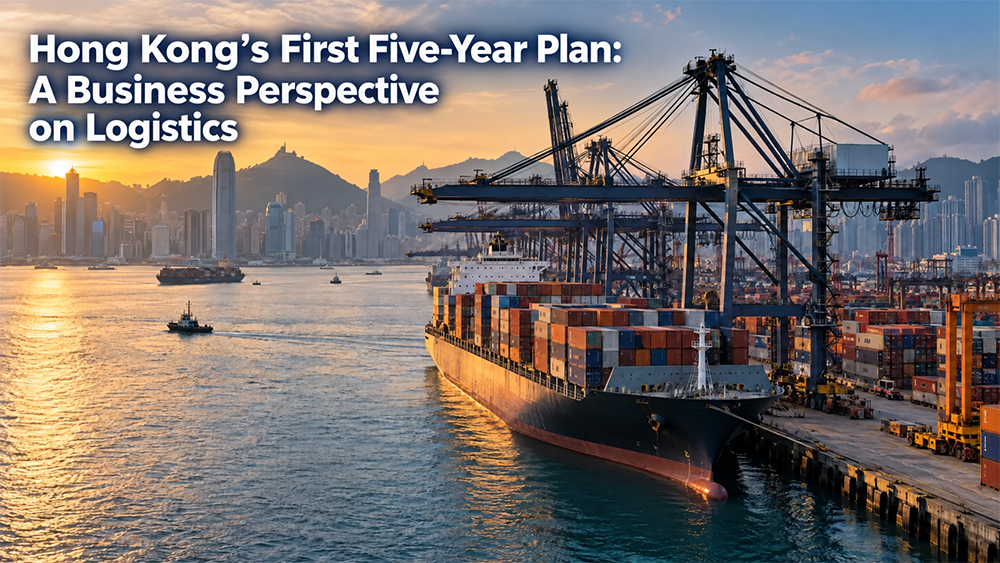
Hong Kong’s First Five-Year Plan for Economic and Social Development sets out strategic priorities for 2026–2030. For the logistics sector, these include smart and green ports, cargo-data connectivity, digital trade, intermodal links, airport and cold-chain capacity, high-value maritime services, green fuels and low-altitude logistics.
This feature is part of a seven-part, business-focused series and examines logistics-related initiatives in the Chief Executive’s 2026 Policy Address. It considers what these measures could mean for logistics operators, shipping and aviation businesses, freight forwarders, supply-chain service providers, technology companies, investors and industry bodies. It distinguishes announced Government measures from potential business implications, while recognising that the initiatives discussed are at different stages of development.

1. Smart and green port operations

What the Policy Address says: The Government will work with port operators on a roadmap for smart transition and green transformation at the Kwai Tsing Container Terminals. It identifies expanded use of autonomous electric vehicles and remotely controlled cranes, and support for onshore power-supply facilities. It will explore port-dues incentives to encourage international liners to use relevant services. The Address says Hong Kong will announce its first green shipping corridor with a trading green port in 2026. Separately, it says the Government will announce the first Green Energy Corridor in collaboration with a Mainland city in 2026. It also sets out the development of green maritime-fuel supply and bunkering, including planned fuel-storage facilities at Tsing Yi South. Planning applications and other statutory procedures are expected to begin in 2027, with tenders for the facilities expected in early 2028.

What this could mean for businesses: Terminal operators and their suppliers may see a policy-driven case for investment in automation, electrification, remote operations and digital control systems. Technology providers may find opportunities in equipment integration, operational software, energy systems and emissions measurement. Shipping lines may need to evaluate the practical availability and cost of onshore power and alternative fuels as infrastructure develops. These are potential areas of activity; the Address does not specify contract awards or guarantee that particular investments will be made.
For fuel suppliers, storage operators and maritime-service companies, the green corridor and bunkering plans could create a longer-term market for fuel sourcing, handling, storage, trading and certification. The relevant facilities and standards are still being planned, so businesses should track procurement, technical specifications, fuel availability and the future carbon-accounting framework. The possibility of port-dues incentives is under exploration and should not be described as an approved rebate.


2. Port Community System, trade finance and SME logistics technology

What the Policy Address says: The Government plans to expand the Port Community System (PCS) through offshore trade-cargo tracking using blockchain technology. It plans a PCS Enabler Recognition Scheme and says the Future Innovative Logistics Acceleration Scheme will provide better support for SMEs adopting innovative logistics solutions that interface with the PCS. The Address reports that more than 8,000 enterprises had registered with the PCS and that trusted cargo-flow data had supported more than 20 successful trade-finance applications. The tracking, recognition-scheme and SME-support measures are planned actions, not evidence that all new services or support are already available.

What this could mean for businesses: For freight forwarders, cargo owners, terminal operators, customs agents, banks and software vendors, PCS integration may become more valuable as cargo data and tracking coverage expand. Businesses that can reliably provide or use trusted shipment data may be better positioned to connect operational visibility with financing workflows. This is an emerging capability—not a guarantee that a lender will approve financing or that every company’s data will be accepted.
SMEs developing or adopting compatible logistics technology should watch for the scheme’s detailed requirements, eligible costs, matching-funding rules, application windows and system-interface standards. The Address states that subsidies will be provided, but firms should confirm the formal programme rules before budgeting or marketing an application as funded.


3. Intermodal freight, inland connections and the Greater Bay Area port network

What the Policy Address says: The Government will strengthen scheduled Chongqing–Shenzhen–Hong Kong and Chengdu–Shenzhen–Hong Kong freight-train services, linked with the Shenzhen–Hong Kong Connect feeder service. The Address says this sea–rail network is expected to shorten cargo transit between the Chengdu–Chongqing region and Hong Kong from two to four weeks to about three days; this is an expected network benefit, not a guaranteed transit time for every shipment. It also notes a Chongqing–Qinzhou–Hong Kong sea–rail service, launched by a container terminal operator and backed by daily liner service. Further work will explore inter-provincial land freight and direct river–sea intermodal transport, and use water-to-water transhipment focused on river–sea intermodality. The Government will study application scenarios, regulatory considerations and possible support measures for autonomous ships. For the Greater Bay Area (GBA), the Government intends to strengthen port collaboration with Huizhou, Dongguan and other cities, improve feeder connections and explore smart feeders to improve efficiency and reduce costs. The stated aim is to enable GBA cargo to move through Hong Kong and support the convergence of shipping routes from Central and South America. Hong Kong will also announce a second batch of partner ports and promote a “brother port” relationship with Shanghai in 2026.

What this could mean for businesses: Shippers and logistics providers may gain more routing choices and stronger links between inland production centres, river ports, seaports and Hong Kong. The announced rail-sea transit-time comparison is a policy-address description of the network’s intended benefit, not a guarantee for every shipment. Actual transit time will depend on schedules, transfer points, customs processes, capacity, cargo type and disruptions.
Forwarders, carriers and exporters may wish to map how these routes fit their origin-destination pairs and service requirements. Smart feeder services, river-sea transhipment and partner-port links may create opportunities in consolidation, feeder operations, documentation and cross-border coordination if the relevant services are implemented and commercially available. Companies should verify service frequency, rates, handling responsibilities and border procedures directly with operators.


4. Hong Kong International Airport, Dongguan Logistics Park and cold chain

What the Policy Address says: Phase 1 facilities of the Hong Kong International Airport (HKIA) Dongguan Logistics Park are scheduled to begin operation in June 2027. Cargo-handling capacity is expected to build gradually to one million tonnes a year. The Park has established a designated supervision area for overseas chilled aquatic products and fresh fruit entering the Greater Bay Area via Hong Kong, supporting a more efficient international cold-chain and air-cargo passage. The Address also identifies aviation-network expansion as a way to reach new passenger and cargo sources. In 2025, HKIA handled 5.07 million tonnes of air cargo, and the Terminal 2 Concourse is scheduled to be commissioned before the end of 2027.

What this could mean for businesses: The Dongguan facility may matter to airlines, freight forwarders, cargo handlers, cold-chain operators, food importers and exporters, and businesses serving GBA consumers. It could support closer coordination between Hong Kong air cargo and Mainland distribution. The announced one-million-tonne capacity is a gradual target, not immediate capacity available at opening. Firms should confirm operating scope, customs and supervision procedures, temperature-control requirements, service charges and access arrangements as the facility opens.
Expanded air-service arrangements and airport capacity could widen route options for time-sensitive or high-value cargo. Businesses should compare route availability, capacity, transit time and total landed cost rather than assume that additional routes automatically mean lower freight costs or guaranteed capacity.


5. Modern logistics clusters, re-export services and supply-chain management

What the Policy Address says: A feasibility study will begin on a “business and trading zone for re-export” intended to remove barriers and ease restrictions on high-value-added logistics services. The Government is preparing an update to the Roadmap for ESG Development for the Logistics Industry. It is also inviting market expressions of interest for the Hung Shui Kiu/Ha Tsuen modern logistics cluster. The development model will be formulated with industry views, and the first land parcels may be released from the end of 2027 at the earliest. The Policy Address continues to advance the previously announced high-value-added supply-chain services centre. It encourages enterprises to use Hong Kong’s finance, trade, shipping, research, branding, design and global networks to connect with overseas supply chains. A preferential package may offer a 5% or half-rate tax concession to qualifying high-value-added enterprises establishing headquarters or regional headquarters to manage supply-chain and sourcing businesses. The Address says the package depends on each enterprise’s investment plan and actual contribution to Hong Kong’s economy; it is not a general tax concession for all logistics companies.

What this could mean for businesses: The logistics cluster and re-export study may be relevant to warehouse and distribution operators, e-commerce fulfilment providers, cold-chain firms, value-added processing, inventory-management businesses and investors in logistics facilities. The cluster’s land release is described as “at the earliest” from late 2027, and the final model has not yet been set. Businesses should monitor the EOI process, land-use and infrastructure details, planning, tendering and eligibility before treating it as a confirmed project pipeline.
For logistics and supply-chain companies, the high-value-services agenda may encourage a shift beyond moving and storing goods toward integrated sourcing, inventory, compliance, data, risk-management and regional coordination services. Any tax-relief claim must be tied to the formal rules and the firm’s eligibility; the Policy Address describes a conditional preferential package, not an automatic entitlement.


6. Digital trade documents and cargo-data connectivity

What the Policy Address says: Phase 3 of the Trade Single Window is intended to provide one consolidated platform for import and export declarations and cargo information across transport modes. The Government plans to expand the “Single Submission for Dual Declaration” arrangement with Mainland customs and advance connection with ASEAN’s Single Window. The Trade Single Window is scheduled to connect with the HKMA’s Commercial Data Interchange in mid-2027. The Address also says the Government will introduce a bill to facilitate digital business-to-business trade documents and improve traceability, and that tokenised-deposit trade-finance use cases will be explored.

What this could mean for businesses: Traders, carriers, logistics providers, customs brokers, banks and technology vendors may need to prepare for more standardised digital documentation and data exchange. This could reduce repeated data entry and improve shipment traceability if platforms connect effectively and businesses adopt compatible processes. It may also make data quality, cybersecurity, permissions and cross-border data handling more important.
The measures are at different stages: platform services are planned, connections have stated timelines, and legislative changes are proposals. Businesses should track the actual bill, implementation dates, technical standards and onboarding arrangements. They should not assume that every existing paper workflow will be replaced immediately or that connection to trade-data platforms ensures credit.


7. Maritime services, green fuels and industry capability

What the Policy Address says: The Government aims to strengthen high-value-added maritime services, including ship management, ship finance, marine insurance, maritime law and arbitration. It has introduced an amendment bill to enhance tax-concession regimes for maritime services and a half-rate concession for physical commodity trading; proposed relief remains subject to legislation and relevant conditions. The Address also proposes dual ship registration to accommodate different commercial operating models and expansion of marine specialty risk-pool underwriting capacity. The Government will promote the establishment of a Hong Kong maritime academy through an industry–institution collaboration model. For sustainable aviation fuel (SAF), the Government is advancing a production base in Dongguan, expected to begin production by 2030, and plans a Hong Kong blending facility to build an end-to-end value chain and reduce logistics costs. It is studying a mandatory consumption-ratio mechanism and a Green Energy Certificate system. The First Five-Year Plan sets a target for SAF to account for 1%–3% of fuel used by flights departing Hong Kong International Airport in 2030. This is a future target, not a current mandate.

What this could mean for businesses: Maritime professional-services providers may benefit from a stronger ecosystem around shipping finance, insurance, registration, arbitration and specialist risk management, subject to market development and enacted rules. Green-fuel initiatives may create demand for fuel logistics, storage, blending, certification, emissions accounting and supply contracts. These markets also involve investment, technology, safety, price and supply risks. Logistics employers may watch maritime training initiatives as a potential response to specialist skills needs.


8. Cross-boundary low-altitude logistics and automation

What the Policy Address says: Under its low-altitude-economy plan, the Government intends to work with the Mainland to launch cross-boundary low-altitude logistics trial flights as early as possible and progressively expand a GBA network. It will study infrastructure and begin developing a Smart Low-altitude Traffic Management System, with progressive implementation targeted from 2028. The Address also proposes drafting legislation for unconventional aircraft over 150 kilograms. Separately, the Government will study possible applications for autonomous ships, relevant regulatory considerations and possible support measures; it has not announced an operational support programme or committed to their deployment.

What this could mean for businesses: Drone and aircraft operators, logistics platforms, insurers, infrastructure providers and cargo owners may be able to test new delivery or time-critical logistics scenarios as cross-boundary arrangements develop. However, the trial flights, airspace-management systems and regulatory framework are still being developed. Operators must account for licensing, payload, safety, insurance, customs, security and cross-boundary approvals before relying on these modes commercially.
For traditional logistics operators, automation may complement rather than replace existing networks, particularly for specialised, urgent or hard-to-reach deliveries. The business case will depend on payload and range, unit economics, network integration, weather resilience and regulatory permissions.

Stay tuned for the next instalment, where we’ll explore what the 2026 Policy Address could mean for businesses in other featured industries. For enquiries about Hong Kong’s First Five-Year Plan, please visit its official website: https://www.hk5yplan.gov.hk/2026-2030/en/index.html

Editor’s note: The Mediazone Group thanks the Hong Kong Government for making information about the First Five-Year Plan available. The analysis in this feature is the Mediazone Group’s independent interpretation of selected Government priorities. It does not constitute Government advice or represent an official Government view. It is not a guarantee of funding, demand, procurement opportunities or commercial success. Businesses should conduct their own research and due diligence and verify relevant information and requirements with the responsible authorities before pursuing any opportunities.